
The Critical Role of Equipment Planning in Lab Design
In life sciences environments, the success of a laboratory is determined long before construction begins. During the pre-construction phase, equipment planning and lab space design are critical to ensuring the facility can fully support the instruments, workflows, and scientific functions it is intended to house. While architects and engineers establish the building’s core and shell, the true performance of a lab depends on how well the space is aligned with the realities of scientific operations.
At Visions Management, we operate at the intersection of design, operations, and execution, bringing a practitioner’s lens to environments that demand precision. We partner alongside design teams and stakeholders to translate complex laboratory workflows into actionable planning requirements, ensuring that infrastructure, equipment, and user needs are fully integrated from the outset.
Our approach goes beyond coordination. We embed equipment planning and lab space design into our broader relocation and transition management methodology, allowing us to identify risks early, drive informed decision making, and create alignment across all project partners. By engaging early in the project lifecycle, we not only reduce operational disruption but also position our clients to activate their new labs with confidence, speed, and long-term functionality.
Designing Around Equipment
Much of the laboratory equipment in a life sciences relocation is far more complex than that of a standard office relocation. An instrument may require some combination of: features for safe handling or hazardous waste collection, non-standard utilities, special environmental conditions, customized structural features, seismic anchoring, and space for service access. Equipment planning and lab design helps to identify and coordinate details such as:
Safe use of the instrument, which may include space considerations for hazardous waste collection containers or adequate and unimpeded space around the instrument for safe operation.
Special electrical requirements, including dedicated circuits, emergency generator power, and uninterruptible power sources
Heat loads and ventilation requirements
Gas, vacuum, and exhaust connections
Structural considerations for heavy equipment, including floor or wall anchoring
Vibration control for sensitive instruments
Without this level of planning, teams often discover issues late in the construction phase when resolving them becomes much more expensive and impactful to the project timeline.
Preventing Costly Design Changes
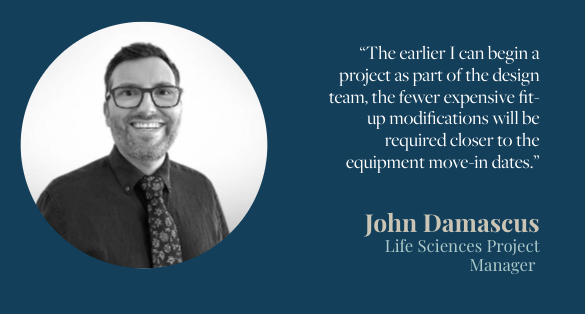
One of the most critical roles of experienced lab planners is identifying potential issues early before they evolve into costly design changes. While equipment needs often shift after i allows for greater flexibility and avoids expensive rework.
Our Life Sciences team brings deep operational expertise to proactively identify gaps such as missing utilities, insufficient infrastructure, and space constraints. By engaging early in the project lifecycle, we provide a layer of foresight that serves as early intervention reducing change orders, minimizing delays, and ensuring the lab is built to support its intended function from day one.
Translating Science Into Design
At Visions, equipment planning and lab design are led by a former bench scientist and lab operations specialist who understands the day-to-day function of a laboratory. That background allows our Life Sciences team to ensure that a science lab’s research workflows are thoughtfully considered through practical lab space design.
Rather than simply reviewing an equipment list, we liaise directly with scientists, lab managers, and field service engineers who service specialty equipment to understand how their instruments will be used, maintained, and integrated into their research processes. This collaboration helps to ensure the final space fully supports the scientists and promotes the longevity of their research.
Supporting the Entire Lab Transition Process
Equipment planning and lab design play a critical role in the broader lab transition process. Because our team is highly experienced with both the relocation of existing equipment and the installation of new equipment, we are able to begin documenting equipment requirements, conditions, and sequencing well in advance of scheduled relocation and installation dates.
Visions’ early coordination and space planning phase supports smoother relocations, reduces the need for additional construction fit-up, and minimizes operational down-time so that labs are ready to operate as soon as science teams occupy the new space.
For organizations building or renovating laboratories, equipment and space planning provide an important layer of coordination that connects the design and construction phases with post-move operational readiness.